





The Battle of Lexington
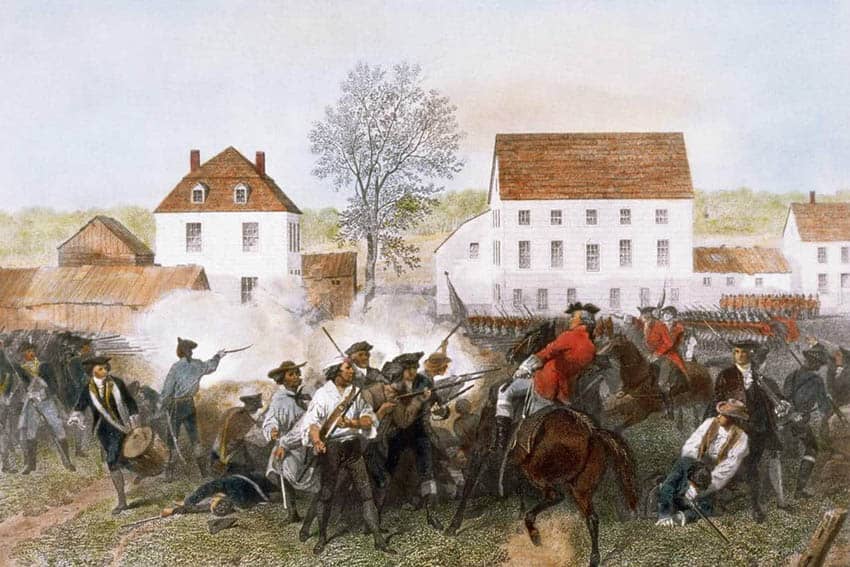
Last week, we left Paul Revere and William Dawes standing in Lexington, Massachusetts, watching the British Redcoats march toward the town. Dr. Samuel Prescott had continued the ride to Concord to warn the patriots of the British approach to capture the American military supplies.
More than 700 British redcoats had risen early the morning of April 19, 1775. They assembled in the center of town in their heavy wool coats, wearing their knapsacks, canteens, cartridge boxes, and white belts with bayonets. The air was very cool with a damp mist in the air. The men were carried across the Charles River in rowboats to Cambridge, where they disembarked. They had no idea where they were going as they formed up and started marching.
In Lexington, just after midnight, the bell started ringing to alert the minutemen and militia that the British were coming. Captain John Parker, a farmer who had fought in the French and Indian War, waited for his men on the triangular-shaped Lexington Green. About 130 minutemen gathered together in the darkness after hurriedly getting dressed and grabbing their weapons. Since there was no sign of the British, about half of the men went back home to get warm, while the rest of the men went to Buckman Tavern to keep warm.
Right before dawn, lookouts spotted the leading companies of the British, about 250 soldiers, approaching Lexington. Major John Pitcairn was leading the column, a man who detested the colonials. Captain Parker ordered the 70 men still with him to form on the green. He knew they could not stop the Recoats, but he wanted to show that the Colonials were brave, serious, and willing to stand up for their rights. They had been told not to start any violence, but to let the King’s troops begin any actions of war.
Captain Parker told his men, “Don’t molest them without they being first.” As the redcoats moved closer, a British officer yelled, “Throw down your arms, ye villains, ye rebels. Disperse immediately!” From somewhere a shot rang out across the Lexington Green.
The Redcoats fired a staggered volley and charged with bayonets. The minutemen fired a few scattered shots and ran. Eight of them lay dead, and nine more had been wounded. The rest had run away. One British soldier had been wounded during the fight. As the Redcoat army reformed on the green, the soldiers were wild with excitement. For most, this had been their first engagement, their first taste of war.
Once the redcoat army assembled, they started the march to Concord, only six and a half miles away. All across Massachusetts, church bells were ringing, and the Minutemen and militia units were forming up. One Patriot said, “We always had governed ourselves, and we always meant to, and the redcoats didn’t mean we should.” The shooting war had started, and it was going to be a long Spring Day.
Thanks for reading “Our History Matters” by T. J. Cox.
Don’t hesitate to get in touch with me at: tj.cox2023@outlook.com
