




Colonel Glover holds back the British Army at Pell’s Point
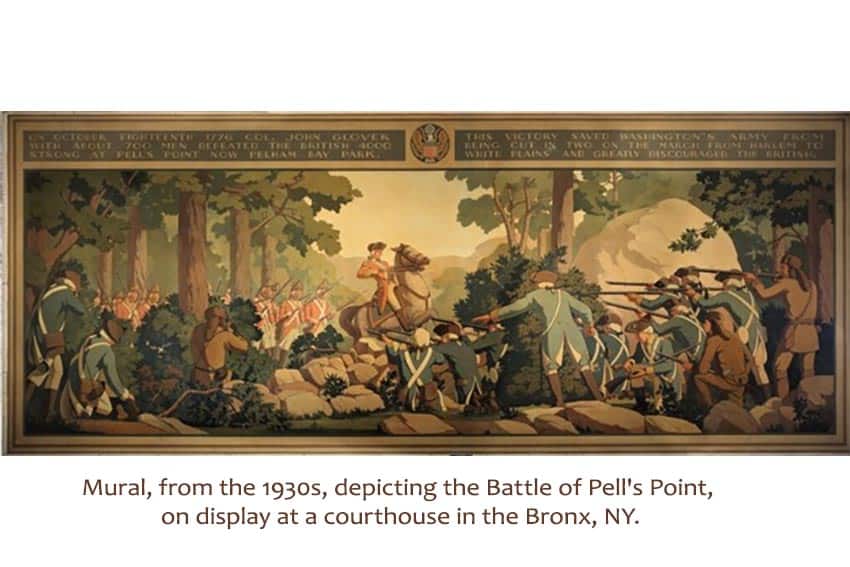 General Washington was moving his army away from New York City. The British army and navy controlled the city and were trying to capture the American Army. On the morning of October 18, 1776, British ships appeared along the shores of Pell’s Point in New York. As thousands of British and German troops came ashore, they wanted to push inland and trap General George Washington and his Continental Army. But waiting ahead of them was a determined American commander named John Glover, with a small brigade of Massachusetts soldiers and a plan that would frustrate the British advance.
Washington recognized the danger. He began moving his army away from northern Manhattan toward White Plains, where he hoped to find a more defensible position. The withdrawal was essential, but the American army needed time to make the journey. Someone would have to slow the British advance.
Colonel John Glover was no stranger to difficult assignments. A successful merchant and shipowner from Marblehead, Massachusetts, he had commanded men who helped transport Washington’s troops across the East River during the daring nighttime evacuation from Brooklyn to Manhattan in August. Many of his soldiers were experienced seamen and fishermen who had become Continental soldiers.
Now, Glover and approximately 750 men from four Massachusetts regiments faced a British force of about 4,000 troops. They were heavily outnumbered, but Glover understood the countryside and knew that good positioning could help make up for the difference in numbers.
Glover placed his men in successive positions behind stone walls. His plan was simple but effective. The Americans would allow the British to advance within close range, fire upon them, and then withdraw to another position. There, the British would encounter another line of determined Patriots waiting behind cover.
As the British troops marched inland, the first Americans opened fire. The surprised British soldiers responded and pressed forward, only to discover that the Americans had fallen back to another stone wall. Once again, the Patriots delivered a sharp volley before withdrawing to their next position.
The fighting continued as the British attempted to push through the American defenses. Each time the British forces advanced, they faced another group of soldiers using the stone walls to their advantage. The American defenders were not trying to defeat the entire British army in a single engagement. Their mission was to delay it—and they were accomplishing that purpose.
The British brought additional troops into the fight, including German soldiers serving alongside the British army. As the hours passed, the larger force began threatening the American positions from the sides. Glover realized that remaining in place much longer could allow his brigade to be surrounded.
He ordered an orderly withdrawal toward the Hutchinson River. The Americans continued to resist as they crossed the waterway, and artillery fire was exchanged between the opposing forces. Eventually, Glover moved his men north toward Tuckahoe, where they could continue supporting Washington’s army.
The battle had cost the Americans 21 men and the British lost 244 men. Colonel Glover had accomplished something important. His small brigade had challenged a much larger force, delayed its advance, and helped prevent the British from closing in on Washington’s retreating army.
For Washington, the delay was invaluable. His army continued moving toward White Plains, escaping the immediate danger of being cut off on Manhattan. The fighting at Pell’s Point had bought the commander in chief something his struggling army desperately needed: time.
That is why the Battle of Pell’s Point deserves a place in our nation’s history. On October 18, 1776, a small brigade of determined Patriots helped protect the army upon which America’s hope for independence depended. Their courage and discipline helped keep the fight for freedom alive.
Thank you for reading “Our History Matters. I always enjoy hearing from readers; contact me at tj.cox2023@outlook.com with your questions, comments, ideas, or suggestions.
