





The Battle of Concord
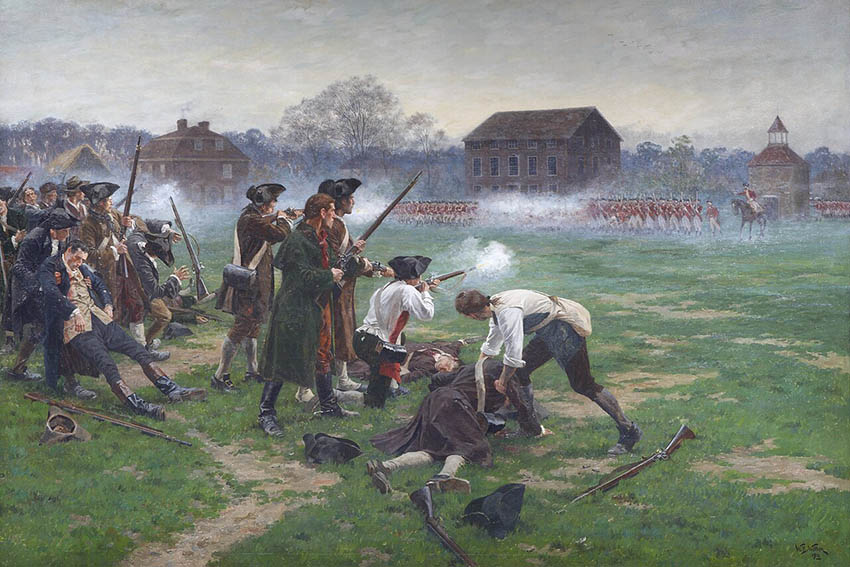
The British marched into Concord, Massachusetts, with Fifes and Drums playing martial tunes. The red-coated soldiers marching in step were prepared and determined to do their duty. They had fired their muskets in Lexington, killing 8 and wounding 9 of the Patriots. One of their own had been wounded also.
The patriot militia and minutemen had traveled during the night, from all over the state, to protect the military stores in Concord. About 450 of them gathered on a hill overlooking the North Bridge. They were trained, ready, and prepared to defend their homes and families.
The British troops searched the town looking for military supplies. Most of it had been removed or hidden from sight. They found about 300 pounds of musket balls and threw them in a mill pond. They found 60 barrels of flour, which they destroyed, and also some wooden artillery carriages, which they chopped up with axes. They piled everything up and set it on fire. They did not find any Black Powder, Guns, or Cannons because they were all gone.
The Patriot soldiers on the hill were watching the British soldiers search the town. Suddenly, they saw smoke rising above the rooftops. Their first thought was that the British were burning the town. The commander of the patriots was Colonel James Barrett. He was a veteran of the French and Indian War, and he was determined to move his men down the hill to protect the town.
The British had three companies of Regulars guarding the North Bridge over the Concord River. Seeing the Patriot army approaching the bridge, the redcoat soldiers retreated across it towards the town. When the Massachusetts soldiers started across the bridge, a shot rang out from somewhere nearby. The front line of redcoats fired a volley across the bridge, killing two patriots and wounding 3 more. The militiamen fired a volley and hit 8 redcoats, killing three. The rest turned and fled.
The British soldiers gathered in the center of town and formed ranks. When all the men were lined up and ready, they began the march back to Boston just before noon. The militia and minutemen ran to get along the sides of the road ahead of them. They hid behind trees, fences, and stone walls and aimed at the British as they marched by. They fired, reloaded, and rushed to get to another location to continue firing.
The British were suffering severe casualties and were running low on ammunition. They were losing soldiers all along the road. The number of American soldiers was increasing as more militia units kept arriving. By the time the redcoats approached Lexington, they were almost ready to quit and surrender. But looking ahead, they saw reinforcements arriving from Boston. A large column of about 1,300 soldiers had come to their rescue. They were led by General Hugh Percy, a no-nonsense soldier who was second-in-command to General Gage.
The relieved redcoats, seeking revenge, started looting houses along the road. They broke in and took anything they wanted. By the time they reached the village of Menotomy, they were fighting house to house. About 25 Americans and about 40 Britons were killed in this one village. The fighting continued along the road all the way to Boston.
Around 6:00 pm, the British soldiers began staggering back into Boston. They were exhausted, thirsty, hungry, and just wanted the day to be over. They had lost about 275 soldiers during the day, with about 75 killed. The Americans had lost about 95 soldiers, with about 50 killed.
As the day ended, the British were safe inside their defenses in Boston. The colonial army surrounded the city. American soldiers continued arriving and joining the defenses surrounding the city. They built earthworks for protection and soon outnumbered the British inside the city. The siege of Boston began. The British would never again march out of the city until next year, when they boarded ships and sailed away.
Thanks for reading “Our History Matters” by T. J. Cox.
Please let me know what you think: tj.cox2023@outlook.com

