




Cline tours apple orchard damaged by freeze
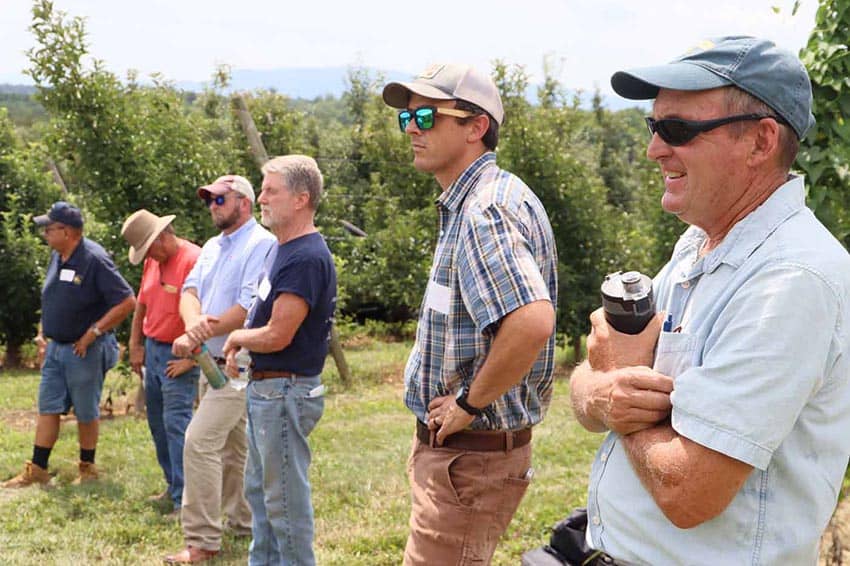
STRASBURG—Branches that are usually laden with Gala apples stood nearly bare at Glaize Orchard Aug. 20, illustrating the scale of spring freeze losses growers are facing statewide.
During a tour of the Shenandoah County orchard followed by a roundtable discussion with growers, U.S. Rep. Ben Cline, R-6th, learned more about the widespread damage caused by late spring frost and freeze events that devastated Virginia fruit crops and vineyards.
“Normally, we’d be pulling about 4,000 bushels of Gala apples off the trees every day,” orchard owner Phil Glaize Jr. said. “But this year, we’re not picking.”
Among their five growing locations, only one is expected to produce about 10% of a normal crop.
“And we have not stopped spending money,” Glaize added.
Virginia Cooperative Extension reports the state’s impacted growers may lose more than $100 million collectively.
“We had two severe late freeze events that horrendously impacted fruits, produce and vineyards,” said Virginia Deputy Secretary of Agriculture Ben Rowe. “Some vineyard operators lost 100% of production in Central Virginia.”
He said state leaders are exploring avenues to establish a Virginia agricultural disaster relief program to complement federal assistance programs.
Scott Johnson, senior vice president of Shawnee Canning Co., said the apple shortage is affecting food processors who depend on Virginia fruit. The company is now looking as far away as Washington State for supplies.
“We can’t not have apple butter next year,” he said.
Stakeholder discussion continued at the Alson H. Smith Jr. Agricultural Research and Extension Center.
Winemaker and industry leader Jennifer Breaux, president of Breaux Vineyards and the Virginia Wineries Association, said reduced production leads to employment disruption, plus declines in industry membership revenues supporting statewide programs.
“The trickle-down effect is immense,” Breaux said. “But I think we’re all going to leave this crisis better educated on how to handle it in the future.”
Fifth-generation peach grower Henry Chiles of Chiles Peach Orchard in Crozet referenced this year’s bottlenecks in H-2A application processing that delayed the arrival of essential agricultural guest workers.
“A bigger threat than a spring freeze is losing a sustainable, legal supply of labor to run these farms,” he said. “If labor is not consistent, we cannot operate any of the businesses represented here.”
He urged Congressman Cline to support the Securing Agriculture’s Workforce Act of 2026—a bipartisan bill to reform and expand the H-2A agricultural guest worker program.
Improvement to the H-2A process is a priority transcending partisan politics, Cline said.
“We want to help make sure those are temporary setbacks,” he said.
Growers thanked the congressman and Gov. Abigail Spanberger’s administration for their efforts to secure a federal freeze disaster declaration, which unlocked low-interest emergency loans. They asked Cline, who sits on the House Appropriations Committee’s Agriculture Subcommittee, to also support ad hoc disaster funds.
“Severe weather events are not partisan issues,” he said. “We’re working together as a team to support you in recovery and continuing forward.”