



Who was Paul Revere?
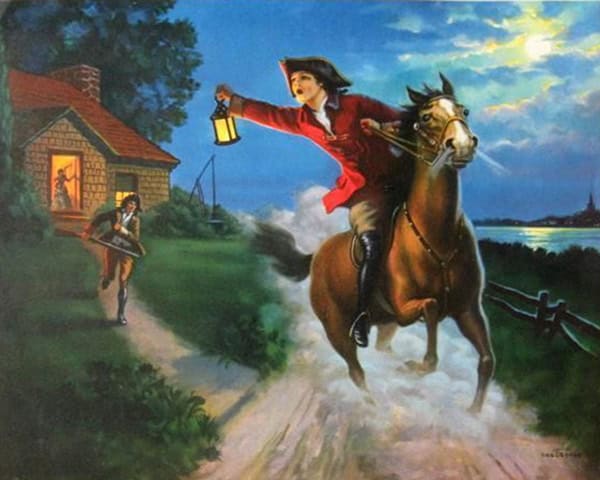
Listen, my children, and you shall hear
Of the midnight ride of Paul Revere,
On the eighteenth of April, in Seventy-five;
Hardly a man is now alive
who remembers that famous day and year.
“Paul Revere’s Ride” by Henry Wadsworth Longfellow – December 1860
Who was Paul Revere? Was he just a silversmith in the city of Boston? Was his only contribution to the revolution a warning ride through the night to Lexington? He was much more than that. He was one of the leaders of the “Sons of Liberty” along with Sam Adams, John Hancock, and Joseph Warren, who were the main leaders of the group. These men were working together to free the colonies from England. They were gathering and planning how to proceed with the revolution. They worked with the other colonies through the Committees of Safety by sending letters to keep everyone informed.
Paul Revere acted as a spy inside the city of Boston. He was a well-known businessman and was considered the best silversmith in the colonies. He received a lot of business from the British soldiers in the city. He helped keep the patriots informed of what the British troops were doing. He led a group of patriot artisans and merchants in the city and also carried patriot messages to other cities as far away as Philadelphia.
On the night of April 18, 1775, the Patriots had received intelligence that the British were planning a raid. Dr. Joseph Warren summoned Paul Revere and William Dawes and sent them on a dangerous mission. They were both riders who spread news for the patriots. It was decided that Revere would cross by boat, over the water to the Charlestown peninsula, the shortest route, and ride toward Lexington to spread the alarm. Dawes would leave Boston on the longer land route, going across the “neck” of land to the countryside. Their mission was to alert the minutemen and militia that the British redcoats were planning to march to Concord to confiscate the weapons, cannons, gunpowder, and other stores belonging to the patriots. They were also to warn Samuel Adams and John Hancock to flee before they could be arrested.
Before he left, Revere had the Church Rector hang two lanterns in the Church Tower as a signal to the Patriots that the British troops would be taking the shorter route across the water. “One if by land, Two if by water.” When he started his ride, there were already British patrols looking for patriots that might warn the towns of their approach. Revere was able to get around the patrols without getting caught. Revere and Dawes both arrived in Lexington a little after midnight. They warned Hancock and Adams, and both men fled. Revere and Dawes were joined by Dr. Samuel Prescott, and after resting, they continued their ride to Concord.
On the road to Concord, the three men were stopped by a British patrol and detained. Dr. Prescott was able to jump his horse over a stone wall and escape. He rode on to Concord, warning the Patriots of the British advance. Dawes also escaped but fell from his horse and walked back to Lexington. Revere was detained and questioned by the British officers, but was released without his horse. He returned to Lexington on foot and arrived there as the British troops were marching into town. He witnessed the opening battle on Lexington Green.
Revere was part of an extensive network of riders that were used to speed communication throughout the towns and countryside. They had planned and trained for this very moment. It was not a spur-of-the-moment idea. There were over 40 riders who were spreading the news and alerting the militia and minutemen that night. The Patriots had spent months gathering intelligence, building an alarm network, establishing contacts, creating signals, training riders, and preparing to take action. On the night of April 18th, 1775, everything worked.
Thanks for reading “Our History Matters” by T. J. Cox.
Contact me at: tj.cox2023@outlook.com

