





Governor Proposes NASA Space Academy
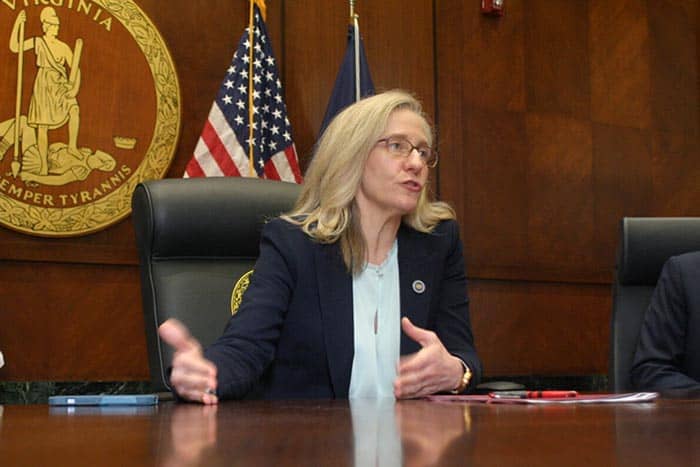 RICHMOND, VA — Governor Abigail Spanberger today announced that the Commonwealth of Virginia submitted a proposal to the National Aeronautics and Space Administration (NASA) to establish the United States Space Academy in Hampton, Virginia.
“Virginia is a world leader in aerospace innovation and national defense, and the Commonwealth is best positioned to be the future home of the United States Space Academy,” said Governor Abigail Spanberger. “With our unparalleled defense footprint and world-class research assets — including NASA’s Langley Research Center — I am confident Virginia can meet the federal government’s ambitious goal and begin training the first class of cadets by 2028. I look forward to working with our entire congressional delegation and federal partners to bring this world-class institution to the heart of Hampton Roads.”
Virginia has proposed a unified campus of more than 600 acres at NASA Langley Research Center and Fort Monroe, with a satellite campus at the Virginia Spaceport Authority’s Mid-Atlantic Regional Spaceport (MARS), located at NASA’s Wallops Flight Facility. NASA Langley would provide the Academy’s research, engineering, flight, innovation, and technical core, while Fort Monroe would support residential life, instruction, leadership development, ceremonies, administration, and public engagement. MARS and Wallops would serve as a satellite learning campus, providing field-based experience in payload integration, space launch and range operations, mission planning, flight safety, uncrewed systems, and post-mission analysis.
Virginia’s proposal outlines a path to welcome approximately 300 cadets in 2028 using existing academic, residential, laboratory, and student support capacity. A statewide consortium led by Virginia Polytechnic Institute and State University including, the University of Virginia, Hampton University, George Mason University, Old Dominion University, Christopher Newport University, and Virginia Commonwealth University would support a unified Academy curriculum spanning fields such as aerospace engineering, data science, cybersecurity, power systems, and aviation.
“Virginia’s proposed Academy, anchored by Fort Monroe and NASA Langley, offers NASA the chance to scale quickly at the heart of an already vibrant space ecosystem,” said Secretary of Commerce and Trade Carrie Chenery. “Through adaptive reuse of existing facilities and a network of industry, research, and academic leaders, Virginia will work with NASA to rapidly realize its vision and meet its needs. Together, we will build an Academy capable of cultivating our next generation of space visionaries.”
This proposal has received support from Virginia’s full congressional delegation, including Senators Mark Warner and Tim Kaine, and Representatives Don Beyer, Ben Cline, Morgan Griffith, Jen Kiggans, Jennifer McClellan, John McGuire, Bobby Scott, Suhas Subramanyam, Eugene Vindman, James Walkinshaw, and Rob Wittman. Click here for the delegation’s letter of support for the proposal to Administrator Isaacman.
In addition, partners across higher education, local government, industry, workforce development, and the Hampton Roads federal and military community have also offered their support to this proposal.
“Virginia has a long history of leading the way in space exploration and innovation, and I enthusiastically support the Commonwealth’s proposal to establish the United States Space Academy,” said Senator Mark Warner. “With NASA Langley, NASA Wallops, the nation’s strongest concentration of military and intelligence community assets, a robust aerospace industry, and a first-rate system of higher education, Virginia has the talent, infrastructure, and expertise to take that leadership to the next level. The Commonwealth’s proposal would build on these strengths, create new opportunities for education and training, and pave the way for the next generation of scientists, engineers, and space explorers.”
“Ensuring our dominance in space is critical to our national security and economic prosperity,” said Senator Tim Kaine. “Virginia is proud to be home to NASA Langley, Wallops Flight Facility, universities, and other private partners that are at the cutting edge of space and aeronautics research. It would be fitting for the United States Space Academy to be in Virginia, and I strongly support the Commonwealth’s proposal.”
“Virginia has always been at the forefront of NASA’s mission,” said Congressman Bobby Scott. “NASA Langley provided the critical calculations for the Apollo missions and has since become our nation’s leading center for aeronautics research. Virginia’s universities have also made significant investments to build up their research capabilities in support of NASA’s mission. As NASA looks to train its next generation of scientists and engineers, Virginia is the clear choice to host the United States Space Academy.”
“Here in Hampton, we take great pride in being the birthplace of the United States Space Program,” said City of Hampton Mayor Jimmy Gray. “What began with state-of-the-art wind tunnels more than a century ago led to a great legacy that includes the Mercury 7 astronauts, the women of ‘Hidden Figures’ and too many technological breakthroughs to name. We thank Governor Spanberger for giving us the opportunity to add the United States Space Academy as the latest part of that legacy. We always say our city’s story reaches From the Sea to the Stars. This is a chance for us to keep reaching higher and higher.”
Virginia’s proposed campus would anchor the Academy within the Commonwealth’s broader space and national security ecosystem. Cadets could access research and flight capabilities at NASA Langley; space launch, range, payload, and mission operations at MARS and NASA Wallops; the extensive military, federal, space, and intelligence ecosystems concentrated across Hampton Roads and Northern Virginia; and Virginia’s statewide aerospace, defense, intelligence, and advanced technology industry. The Commonwealth’s submission is preliminary and nonbinding, with final commitments subject to further planning and required federal, state, local, institutional, and governing-body approvals.
Announced in September, NASA’s Request for Information calls for “a NASA-led, civilian Federal academic institution that combines rigorous technical education with disciplined leadership development, civic responsibility, and a lasting commitment to public service. The Academy will prepare future scientists, engineers, astronauts, pilots, operators, entrepreneurs, civil servants, warfighters, and other leaders to advance American interests across the aerospace sector.”
Secretary of Commerce and Trade Carrie Chenery, who also serves as the State Selecting Official, and Secretary of Education Jeffery Smith co-chaired the Commonwealth’s effort to prepare a response. The Virginia Economic Development Partnership serves as the Commonwealth’s responding entity and coordinated the submission with entities including the Virginia Spaceport Authority, and a broad coalition of state agencies, regional and local partners, and universities.