



Response to Drought in Roanoke Region
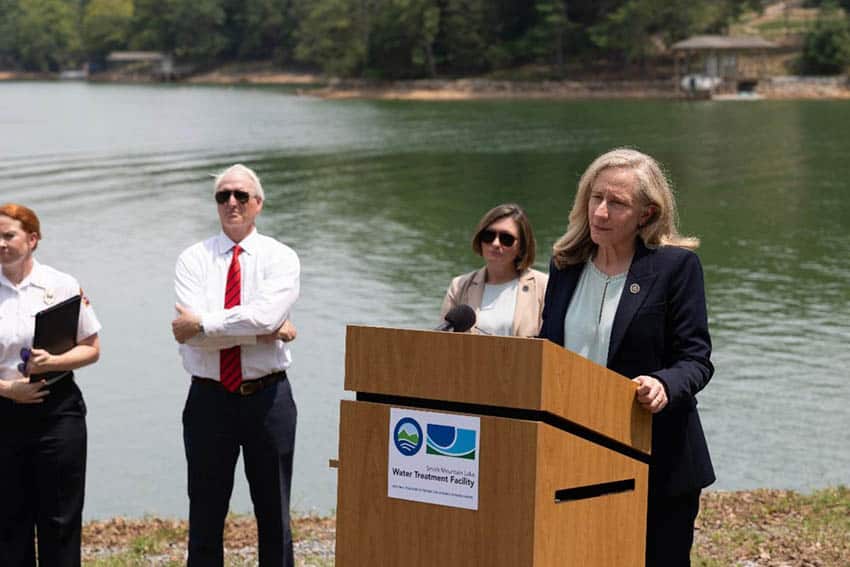 Governor Abigail Spanberger joined state and local leaders at Smith Mountain Lake to update Virginians on the status of the worsening drought, encourage residents and businesses to continue taking commonsense steps to conserve water, and outline the steps the Commonwealth is taking to protect the water supply statewide.
“Last week, the Drought Monitoring Task Force recommended emergency status for the Roanoke region,” said Governor Abigail Spanberger. “Most of Virginia is under a drought watch or warning, and states up and down the East Coast have been facing drought conditions as well. Thank you to all Virginians who are helping preserve our water supply right now by using commonsense water conservation measures. Millions of small choices add up and will make a big impact.”
Governor Spanberger continued, “To the Virginians who call this region home — you are not carrying this alone. The full weight of your state and local governments is hard at work to see this through. This impacts us all, and while we cannot control the amount of rainfall we will get in the future, we can control how to use the water we have.”
Governor Spanberger was joined by Secretary of Agriculture and Forestry Katie Frazier, Secretary of Natural and Historic Resources David Bulova, and Senator Mark Peake. The Governor was also joined by agriculture and water management leaders — including Virginia Farm Bureau Federation President Scott Sink, Bedford Regional Water Authority Executive Director Brian Key, and Virginia Department of Health Office of Drinking Water Director Dwayne Roadcap.
“While we can’t control the rainfall, we can make sure that we do all we can to conserve our water resources — and to make sure that the public is well informed about potential next steps,” said Secretary of Natural and Historic Resources David Bulova. “That plan established the Drought Monitoring Task Force and lays out a systematic process for not only tracking drought — but for how to coordinate with our local and federal partners when it looks like drought may be imminent. While many Virginians rely on large water systems, many others rely on smaller systems or individual wells. That is why a coordinated approach and communication is so important.”
“Across farms in every corner of Virginia, the lack of rain has severely impacted planting of crops, the availability and quality of hay and pasture for our livestock producers, and much needed irrigation for growing crops and raising livestock,” said Secretary of Agriculture and Forestry Katie Frazier. “Virginia farmers and all Virginians should rest assured knowing that our Governor, our Secretariat of Agriculture and Forestry, and our entire administration are committed to facing this drought alongside them.”
“Water is a precious resource, and it is short right now,” said Senator Mark Peake. “Please be careful with how you use water, pay attention to what you’re doing, and we will work this out. We know that state, federal, and local government are there to work with us.”
“We’ve been feeling the effects of the drought in this area since 2025,” said Virginia Farm Bureau Federation President Scott Sink. “Farmers have always conserved water and are always under voluntary restrictions because we understand how precious water is. Anything we can do to help these farm families help keep food and shelter is paramount.”
“Water isn’t just something that’s fun to play in or something that improves the quality of our life. It’s the very essence of life itself,” said Bedford Regional Water Authority Executive Director Brian Key. “Water is the single most important resource. I want to thank the Governor and her staff for being here today. We really appreciate bringing this issue to the forefront, and for highlighting the importance of the life-giving aspect of water.”
“We have a lot of hardworking people at the municipal plants who are doing really good work, monitoring groundwater levels, monitoring reservoir water levels, and monitoring stream flow,” said Virginia Department of Health Office of Drinking Water Director Dwayne Roadcap. “That information is being fed with our Department of Environmental Quality. It’s going to the Drought Monitoring Task Force. There’s active monitoring.”
While most of the Commonwealth remains in either a drought warning or watch status, the Roanoke Drought Evaluation Region — which includes Bedford, Campbell, Charlotte, Franklin, Halifax, Henry, Mecklenburg, Patrick, Pittsylvania, and Roanoke counties, and the cities of Danville, Martinsville, Roanoke, and Salem — has reached emergency status. On July 7, Virginia’s Drought Monitoring Task Force (DMTF) recommended a drought emergency for the Roanoke Drought Evaluation Region. As a result, local and regional leaders are working together to determine next steps if the situation does not immediately improve.
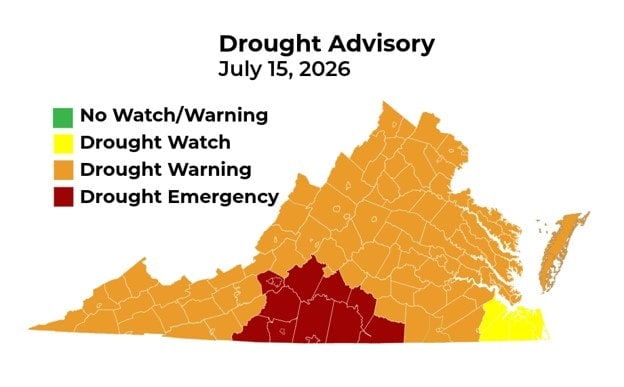
CURRENT DROUGHT STATUS
All areas of the Commonwealth continue to experience record historic drought conditions. The situation in Roanoke has worsened according to key indicators, including:
- Rain is approximately 7.8 inches below normal on average throughout the Commonwealth. This represents the second driest water year on record. The Roanoke Drought Evaluation Region has only received 57 percent of the rain that is normal for this time of year. While the seven‑day forecast calls for continued isolated rain events, below‑normal totals (less than 0.5 inch) are forecast for the New River and Roanoke Drought Evaluation Regions.
- Streamflow within the James River, Meherrin River, New River, and Roanoke River watersheds continue to have significant deficits. Surface water flow for the Roanoke Drought Evaluation Region is below the 5th percentile.
- Soil moisture remains well below normal, with the driest conditions persisting along the Blue Ridge Mountains and along the central and eastern portions of the Virginia-North Carolina border.
- Groundwater levels continue to be depleted in the region. Many groundwater wells in the Roanoke Drought Evaluation Region continue to set provisional record daily low water levels. Groundwater levels in the Roanoke Drought Evaluation Region are below the 5th percentile. The long-term outlook for groundwater levels remains a concern and will take a prolonged period of additional rainfall to recover.
- Reservoir levels at Smith Mountain Lake and John Kerr Reservoir are much lower than normal, at 5.5 feet and 4.45 feet below normal, respectively.
Should the situation continue, a drought emergency declaration may be required — as recommended by the Drought Monitoring Task Force — to activate mandatory non-essential water use restrictions, as called for in Virginia’s Drought Assessment and Response Plan. This plan has been in effect in the Commonwealth since 2003 and was developed after the last time Virginia experienced a drought of this level.
Mandatory non-essential water use restrictions that are not currently in effect, but may be required in the future, include restrictions on:
- Irrigation of lawns, gardens, and landscape materials;
- Irrigation of golf courses;
- Irrigation of athletic fields;
- Washing of paved surfaces, including streets, roads, sidewalks, driveways, garages, parking areas, tennis courts, and patios;
- Washing or cleaning of mobile equipment, including automobiles, trucks, trailers, and boats, except washing of public safety or highway construction and maintenance vehicles as necessary to preserve the proper functioning and safe operation of the vehicle or washing of agricultural equipment for biosecurity;
- Operation of ornamental fountains, artificial waterfalls, misting machines, and reflecting pools;
- Filling and topping off outdoor swimming pools.
In addition, should a drought emergency be declared, the Department of Environmental Quality (DEQ) will require industrial water users to reduce water withdrawals to protect essential water uses for public safety, health, and welfare. For the duration of a drought emergency, the DMTF would continue to assess conditions and provide weekly updates. The DMTF will hold their next meeting on Tuesday, July 21, 2026.
Additional information on the current drought status is available on Drought Dashboard, which includes interactive data on stream gages, groundwater wells, soil moisture, and precipitation.