






June 1776
 June 1776 was one of the most important months in American history. The thirteen colonies were moving steadily toward a final break with Great Britain. Years of political disputes, protests, boycotts, and armed conflict had convinced many Americans that reconciliation with the Crown was no longer possible.
On June 7, 1776, at the Second Continental Congress in Philadelphia, Virginia delegate Richard Henry Lee introduced what became known as the Lee Resolution. Its most famous declaration stated that the colonies “are, and of right ought to be, free and independent States.” Delegates from Virginia and seven other colonies had already received instructions from their governments to support independence. The movement toward nationhood was gaining momentum, and the dream of a new republic was becoming a reality.
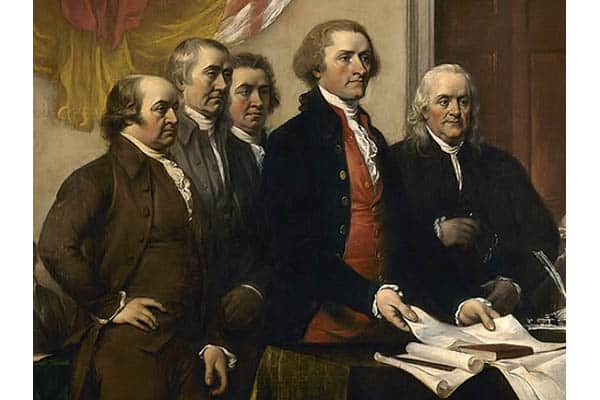
Four days later, on June 11, Congress appointed a Committee of Five to draft a formal declaration explaining why the colonies were separating from Great Britain. The committee consisted of Thomas Jefferson of Virginia, John Adams of Massachusetts, Benjamin Franklin of Pennsylvania, Roger Sherman of Connecticut, and Robert R. Livingston of New York.
Although all five men contributed ideas and revisions, Thomas Jefferson became the principal author of the document. At only thirty-three years old, he was the youngest member of the committee. Jefferson was selected because of his education, his understanding of Enlightenment philosophy, and his exceptional writing ability. Working largely alone in his rented room in Philadelphia, he drafted what would become one of the most influential political documents in history.
John Adams, who had been one of the strongest advocates for independence, played a vital role in guiding the committee’s work. He reviewed Jefferson’s draft and offered suggestions to strengthen its legal arguments and persuasive power.
Benjamin Franklin, the oldest and most experienced member of the committee, provided wisdom, editorial advice, and valuable revisions. His influence helped refine the language and tone of the declaration.
Roger Sherman contributed ideas and wording to the document. He holds the unique distinction of being the only Founding Father to sign all four major documents that helped establish the United States: the Continental Association, the Declaration of Independence, the Articles of Confederation, and the United States Constitution.
Robert R. Livingston also assisted with drafting and editing. However, he returned to New York before the Declaration was signed and was therefore unable to add his name to the final document. Years later, he would play a key role in negotiating the Louisiana Purchase from France.
While the Committee of Five labored over the declaration in Philadelphia, events across North America continued to shape the course of the Revolution.
To the north, the Continental Army was retreating from Canada after a failed campaign to convince Canadians to join the American cause. Disease, supply shortages, and British resistance had brought the expedition to an unsuccessful end.
In the South, British leaders prepared a major offensive against Charleston, South Carolina. Supported by both army and naval forces, they hoped to rally Loyalist support and regain control of the southern colonies.
Meanwhile, General George Washington concentrated his forces around New York City. He anticipated that the British would soon launch a massive invasion from their bases in Nova Scotia and elsewhere. Both sides understood that New York would be one of the most important battlegrounds of the war.
As if war were not enough, the colonies were also suffering through a devastating smallpox epidemic. The disease spread rapidly through human contact and affected people of every race and background—Europeans, Africans, and Native Americans alike. Thousands died. With no cure available, communities relied on quarantine and isolation to slow the spread. Some individuals chose inoculation, a relatively new and risky procedure that exposed a person to a mild form of the disease in hopes of providing future immunity.
Throughout these difficult times, many Americans found inspiration in the writings of Thomas Paine. In his influential pamphlet Common Sense, he declared, “The cause of America is in great measure the cause of all mankind.” His words reflected the belief that the struggle for American independence represented something larger than a colonial rebellion. Around the world, people watched closely to see whether a new nation founded on the principles of liberty and self-government could succeed.
–TJ Cox

